
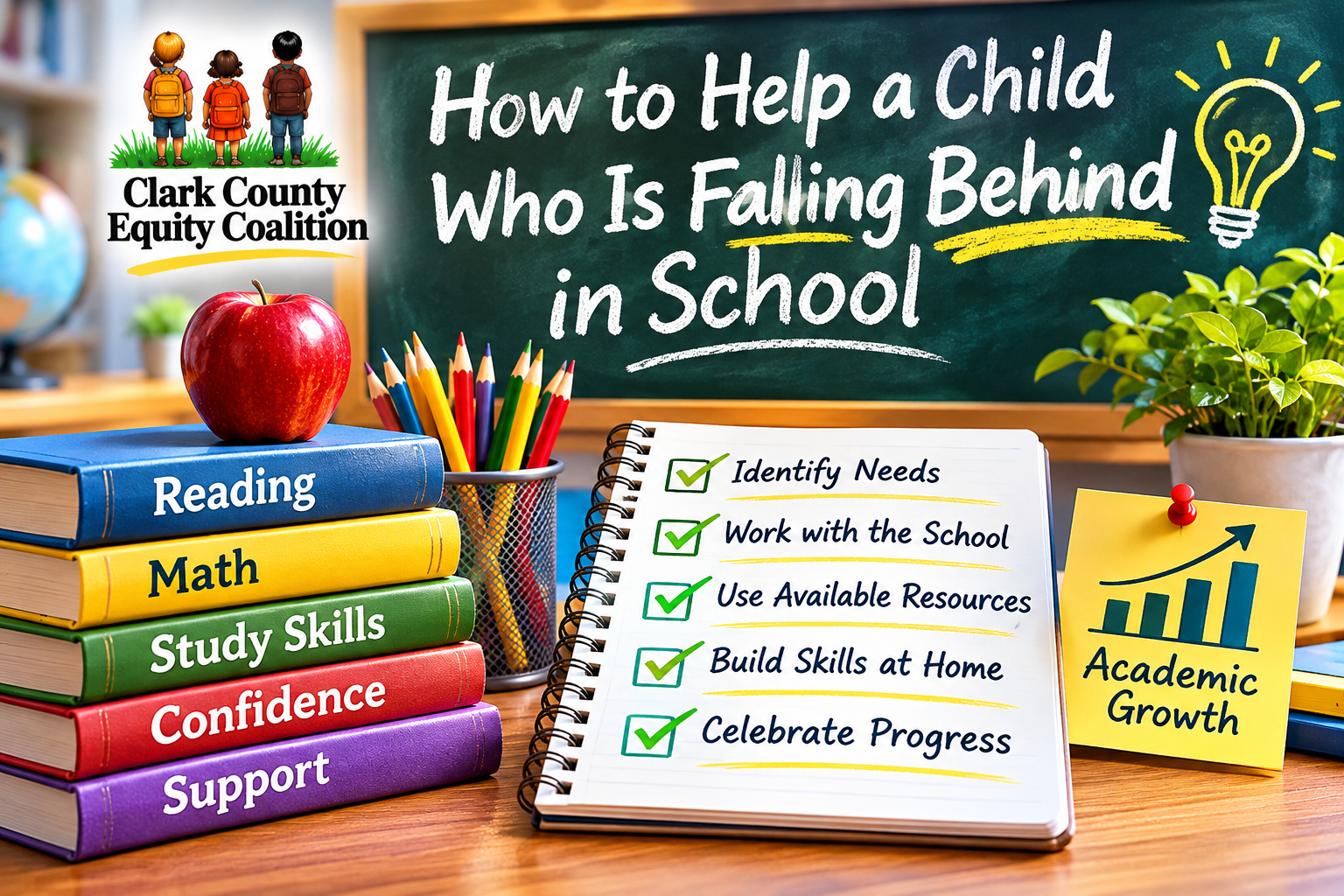
Every parent wants to see their child succeed in school. Whether celebrating a great report card, watching a child learn to read, or helping them prepare for an important test, families play an essential role in their children’s education.
But what happens when a child begins falling behind?
Perhaps your child has started bringing home lower grades. Maybe homework that once took 20 minutes now takes more than an hour. Or perhaps their teacher has expressed concerns about reading comprehension, mathematics, or classroom participation.
These situations can be stressful for both children and their families.
Fortunately, learning how to help a child falling behind in school can make a meaningful difference in their academic progress, confidence, and long-term success.
At Clark County Equity Coalition, we believe every student deserves access to educational opportunities and support that recognizes their individual needs.
We also understand that academic challenges do not mean a child lacks intelligence, motivation, or potential.
Sometimes, students simply need additional instruction, different learning strategies, emotional support, or assistance overcoming challenges outside the classroom.
This guide explores the warning signs of academic difficulties, common reasons children fall behind, and practical steps Kentucky parents can take to help their children succeed.
Why Do Some Children Fall Behind in School?
Academic struggles can develop for many reasons.
Some students have difficulty understanding particular subjects, while others experience challenges that affect their ability to concentrate, complete assignments, or participate in classroom activities.
Common contributing factors include:
-
Learning gaps from previously missed instruction.
-
Difficulty understanding reading or mathematics concepts.
-
Frequent school absences.
-
Attention and concentration difficulties.
-
Changes in family circumstances.
-
Anxiety, stress, or emotional challenges.
-
Bullying or negative school experiences.
-
Limited access to learning materials or technology.
-
Disabilities that affect learning.
-
Differences between instructional methods and a student’s learning needs.
Sometimes, several factors contribute to the same problem.
For example, a student who misses school because of illness may fall behind in mathematics. As the lessons become more difficult, the child may feel embarrassed about asking questions.
That embarrassment may eventually affect classroom participation and confidence.
Understanding the underlying cause is often more helpful than focusing exclusively on grades.
2. Talk to Your Child Without Making Them Feel Ashamed
One of the most important steps while you help a child falling behind in school is creating an environment where they feel comfortable discussing their difficulties.
Children may already feel embarrassed when they cannot complete assignments as easily as their classmates.
Statements such as “You just need to try harder” may unintentionally make them feel that their struggles reflect a personal failure.
Instead, parents can approach the conversation with curiosity and reassurance.
Consider asking:
-
Which subjects feel the most difficult right now?
-
Is there anything you wish your teacher explained differently?
-
Do you understand the assignments but struggle to finish them?
-
Are you comfortable asking questions in class?
-
Is something happening at school that makes learning harder?
-
What do you think would help you feel more confident?
Listen carefully to their responses.
A child who struggles with reading may need targeted literacy instruction.
A student who understands the material but rarely completes assignments may need organizational support.
Another child may be dealing with stress that makes concentrating difficult.
The goal is to understand what the student is experiencing before deciding how to help.

3. Communicate With Your Child’s Teacher
Teachers can provide valuable insight into a student’s academic performance and classroom experiences.
If you need notice a child falling behind in school, schedule a conversation with their teacher rather than waiting for the next report card or parent-teacher conference.
During the meeting, ask about the student’s strengths as well as their difficulties.
For example, a teacher may explain that your child participates enthusiastically in science discussions but struggles to understand written instructions.
That information can help identify a more specific learning need.
Questions Parents Should Ask Teachers
-
Which academic skills is my child struggling with?
-
When did you first notice these difficulties?
-
How is my child performing compared with grade-level expectations?
-
What classroom interventions have already been attempted?
-
Are there particular assignments or assessments that reveal learning gaps?
-
What additional academic support is available?
-
How can we reinforce important skills at home?
-
How will we monitor improvement?
A productive parent-teacher conversation should result in a clearer understanding of the problem and possible next steps.
The Kentucky Department of Education’s Parent and Family Connection Hub provides information designed to strengthen relationships between families and schools.
4. Ask About Academic Intervention Programs in Kentucky
Parents may not realize that Kentucky schools use structured systems to identify students who need additional academic support.
One important framework is the Kentucky Multi-Tiered System of Supports (KyMTSS).
According to the Kentucky Department of Education, KyMTSS integrates classroom instruction, assessments, targeted interventions, and ongoing progress monitoring to support student achievement.
The framework generally includes three levels of support.
Tier 1: High-Quality Classroom Instruction
Tier 1 includes the core instruction and educational supports provided to all students.
Teachers may use different instructional approaches to help students understand grade-level material.
Tier 2: Targeted Academic Interventions
Students who need additional assistance may receive targeted instruction.
This could involve small-group reading support, additional mathematics instruction, or other evidence-based interventions addressing specific skill gaps.
Tier 3: Intensive Individualized Interventions
Students with more significant or persistent needs may receive increasingly intensive instruction and individualized support.
The appropriate level of intervention depends on assessment results and the student’s progress.
Importantly, these tiers describe the intensity of support rather than labeling students.
Parents can learn more through the Kentucky Department of Education’s KyMTSS resources.
If your child is struggling, ask the school whether an academic intervention plan is appropriate and how progress will be measured.
5. Explore Tutoring and Additional Learning Support
Sometimes, students benefit from additional instructional time outside their regular classroom lessons.
Tutoring can provide opportunities to revisit difficult concepts, ask questions, and practice essential skills.
However, effective tutoring should address a student’s actual learning needs.
For example, a child struggling with reading comprehension may need help with foundational decoding skills rather than simply being assigned more reading passages.
Parents should ask teachers which specific skills need improvement before selecting a tutoring program.
Types of Academic Support to Consider
School-based tutoring: Some schools offer academic assistance before school, after school, or during designated intervention periods.
Extended School Services: Kentucky’s Extended School Services program is intended to help eligible students who experience difficulty in one or more academic content areas. Availability and delivery vary by district.
Community learning programs: Libraries and community organizations may offer homework assistance, educational activities, or referrals to tutoring resources.
Individual tutoring: Qualified tutors may provide personalized instruction focused on specific subjects or learning needs.
The Kentucky Department of Education’s Targeted Interventions page provides information about academic intervention approaches and Extended School Services.
Before paying for private tutoring, families should ask their child’s school which supports are already available.

6. Create a Supportive Learning Environment at Home
It’s important to understand to help a child falling behind in school does not mean parents must become full-time teachers.
Instead, families can establish routines that make learning more manageable.
Designate a Consistent Study Space
Choose a location where your child can complete assignments with minimal distractions.
The space does not need to be elaborate.
A quiet table, appropriate lighting, and access to necessary school supplies may be enough.
Establish a Homework Routine
Consistent routines can help children develop organizational habits.
Try setting aside a regular time for homework while allowing reasonable breaks.
Younger children may benefit from shorter study periods, while older students may need help organizing longer assignments.
Break Large Assignments Into Smaller Tasks
A lengthy assignment can feel overwhelming to a struggling student.
Breaking the work into smaller steps may help the child focus on one achievable goal at a time.
Encourage Questions
Let your child know that asking for help is part of learning.
When they do not understand something, encourage them to explain which part is confusing.
Celebrate Effort and Progress
Recognize improvements rather than focusing only on final grades.
Completing an assignment independently, understanding a previously difficult concept, or asking a teacher for clarification are all meaningful accomplishments.
7. Make Reading a Regular Family Activity
Reading skills influence learning across nearly every academic subject.
Students need reading comprehension to understand mathematics word problems, science textbooks, history assignments, and classroom instructions.
For children struggling with literacy, regular reading activities can provide valuable practice.
Parents can:
-
Read age-appropriate books together.
-
Allow children to choose subjects they enjoy.
-
Discuss characters, events, and important ideas.
-
Ask questions about what happened in a story.
-
Encourage children to summarize information in their own words.
-
Visit the public library regularly.
However, reading together should complement—not replace—specialized instruction when a child has significant literacy difficulties.
The Kentucky Department of Education’s Read to Succeed resources offer information about the state’s approach to improving early literacy instruction.
Families in Winchester can also explore educational materials and activities through the Clark County Public Library.
8. Understand the Connection Between Mental Health and Academic Performance
Academic struggles are not always caused by difficulty understanding schoolwork.
Stress, anxiety, depression, grief, bullying, and other emotional challenges can affect concentration, memory, motivation, and classroom participation.
For example, a child experiencing anxiety may understand a subject but struggle during tests.
Another student may find it difficult to complete assignments because of ongoing stress at home.
Parents should pay attention to emotional changes accompanying academic difficulties.
Signs that additional support may be needed include persistent sadness, increased irritability, sleep problems, school avoidance, or significant changes in behavior.
A school counselor, pediatrician, or qualified mental health professional may help identify appropriate support.
The CDC’s Children’s Mental Health resources provide information about emotional and behavioral well-being.
Supporting student success means considering the whole child, not simply their academic performance.
9. Know When to Ask About an Educational Evaluation
Some children continue to struggle even after receiving additional classroom instruction and targeted academic support.
When difficulties persist, parents may want to discuss whether an evaluation for a suspected disability is appropriate.
Under the Individuals with Disabilities Education Act (IDEA), eligible students with disabilities may receive specially designed instruction through an Individualized Education Program (IEP).
Other students may qualify for accommodations or related supports under Section 504.
A student does not automatically qualify for an IEP because they are earning low grades.
Eligibility depends on applicable legal criteria and an individualized evaluation.
Importantly, parents do not have to wait for a child to fail repeatedly before requesting an evaluation when they suspect a disability.
The school must follow applicable procedures when responding to evaluation requests.
Parents can explore the Kentucky Department of Education’s Special Education Parent and Family Resources to better understand their rights and available services.

10. Monitor Progress and Adjust the Support Plan
Helping a struggling student is an ongoing process.
After developing a plan with teachers or other school personnel, parents should monitor whether the interventions are producing meaningful improvement.
Progress may be measured through:
-
Classroom assessments.
-
Reading fluency or comprehension measures.
-
Mathematics skill checks.
-
Assignment completion.
-
Teacher observations.
-
Intervention progress reports.
-
Student feedback.
Ask educators how frequently progress will be reviewed and what changes may be considered if the current approach is not effective.
For example, if a student receives additional reading instruction but makes limited progress, the school may need to reconsider the instructional approach, intervention intensity, or whether further assessment is appropriate.
Progress monitoring helps families and educators make decisions based on evidence rather than assumptions.
11. Help Your Child Rebuild Academic Confidence
One of the most difficult consequences of falling behind in school is the impact on a child’s self-confidence.
Students may begin comparing themselves negatively with classmates.
They may avoid challenging assignments because they expect to fail.
Some children even begin describing themselves as “bad at school.”
Parents can help challenge these beliefs.
Remind your child that learning happens at different rates and that needing assistance does not diminish their abilities.
Encourage them to recognize their strengths outside difficult academic subjects.
A child struggling with reading may excel in art, science, music, athletics, or problem-solving.
Those strengths are important.
Set realistic goals that allow students to experience progress.
For example, instead of expecting a struggling student to immediately earn an A in mathematics, begin by focusing on understanding a particular concept or completing assignments more consistently.
Small achievements can help rebuild confidence and motivation.
12. Build Stronger Partnerships Between Families, Schools, and Communities
No single person can address every challenge affecting a child’s education.
Parents understand their children’s experiences at home.
Teachers observe their learning in the classroom.
School counselors may identify emotional or social concerns.
Community organizations can help families connect with resources that address challenges beyond academics.
When these groups communicate and collaborate, students benefit from a more coordinated approach.
For families facing transportation difficulties, financial hardship, housing instability, or other barriers, connecting with appropriate community resources may also support educational stability.
Kentucky families can explore Kentucky 211 for referrals to community services.
Parents may also contact their child’s school-based Family Resource and Youth Services Center to ask about available assistance.
Educational success is strengthened when families have access to both academic support and resources that help meet their everyday needs.
How Clark County Equity Coalition Supports Educational Opportunity
At Clark County Equity Coalition, we believe every student has strengths worth developing and potential worth supporting.
We recognize that educational challenges can affect students from many different backgrounds and circumstances.
Some children need additional academic instruction.
Others need emotional support, stronger relationships with educators, or access to community resources.
Families may also need reliable information about school processes and educational support options.
Our mission emphasizes community collaboration, education, well-being, culture, and resources that help strengthen opportunities for students and families.
We encourage parents to stay engaged in their children’s education, communicate openly with teachers, and seek assistance when concerns arise.
We also believe that schools and communities benefit when they work together to recognize barriers and identify practical solutions.
Families interested in learning more can visit Clark County Equity Coalition to explore our mission and commitment to educational opportunity.
Frequently Asked Questions About Helping a Child Who Is Falling Behind in School
What should I do first if my child is falling behind in school?
Begin by talking with your child and scheduling a conversation with their teacher. Identify the specific academic skills causing difficulty, discuss possible contributing factors, and ask what support is available.
Can a child catch up after falling behind academically?
Many students can make meaningful progress with appropriate instruction, targeted intervention, and consistent support. The amount of time needed depends on the child’s learning needs and the size of the academic gaps.
Does falling behind mean my child has a learning disability?
No. Academic difficulties can result from many factors, including missed instruction, emotional challenges, or gaps in foundational skills. Persistent difficulties may warrant further assessment.
Are there free academic intervention programs in Kentucky?
Kentucky schools provide instructional supports through systems such as KyMTSS. Some districts also offer Extended School Services or other academic assistance. Families should contact their child’s school to learn which programs are available.
How can I help my child without making homework stressful?
Create a predictable routine, break assignments into manageable steps, encourage questions, and celebrate progress. If homework regularly causes significant frustration, discuss the concern with your child’s teacher.
Final Thoughts: Every Child Deserves the Opportunity to Succeed
Learning how to help a child who is falling behind in school begins with understanding that academic struggles do not define a student’s intelligence, abilities, or future.
Children learn in different ways and may encounter challenges at different points in their educational journeys.
Some students need additional instruction.
Others benefit from tutoring, organizational strategies, emotional support, or a more individualized approach to learning.
The most important step is recognizing concerns early and responding with understanding.
When parents communicate with teachers, explore available resources, and encourage their children through challenges, they can help create a stronger foundation for academic success.
At Clark County Equity Coalition, we believe every student deserves the opportunity to learn, grow, and reach their full potential.
By strengthening relationships between families, educators, and community organizations, we can help children throughout Clark County and Kentucky overcome barriers and build brighter futures.
Learn more about our mission and commitment to student success at Clark County Equity Coalition.
Together, we can help ensure that students receive the encouragement, opportunities, and support they need to succeed.